Anyone who drives on I-24 in Nashville knows how unpredictable it feels. One minute traffic moves fine. The next minute brake lights stretch for miles. There is no crash. There is no construction. Yet everything slows down. That frustration does not happen by accident. It happens because traffic flow is unstable. And fixing that instability is exactly what transportation engineering aims to do.
Instead of only adding lanes, modern transportation engineering focuses on managing how vehicles move. One of the smartest tools now active in Middle Tennessee is the Variable Speed Limit system on I-24. While it may look simple from the outside, it plays a powerful role in reducing congestion.
Why I-24 Traffic Breaks Down So Easily
I-24 carries thousands of commuters, delivery trucks, and travelers every day. Because Nashville continues to grow, traffic volumes stay high almost all day long.
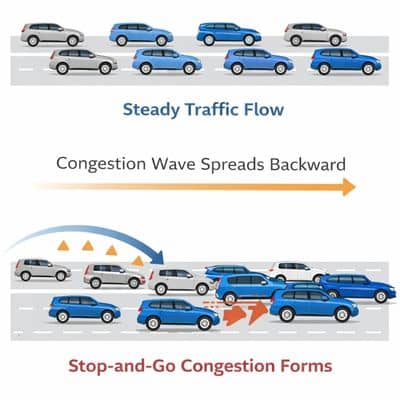
However, most traffic jams do not begin with a major event. In fact, they often start with something small. One driver taps the brakes. The next driver reacts more sharply. Then the slowdown spreads backward through traffic like a ripple in water. Within seconds, cars come to a stop.
As a result, drivers experience what feels like random congestion.
For years, the common fix involved widening highways. While that can help in some areas, it does not always solve unstable flow. Therefore, transportation engineering now looks deeper at driver behavior, spacing between cars, and real-time traffic patterns.
What Variable Speed Limits Really Do
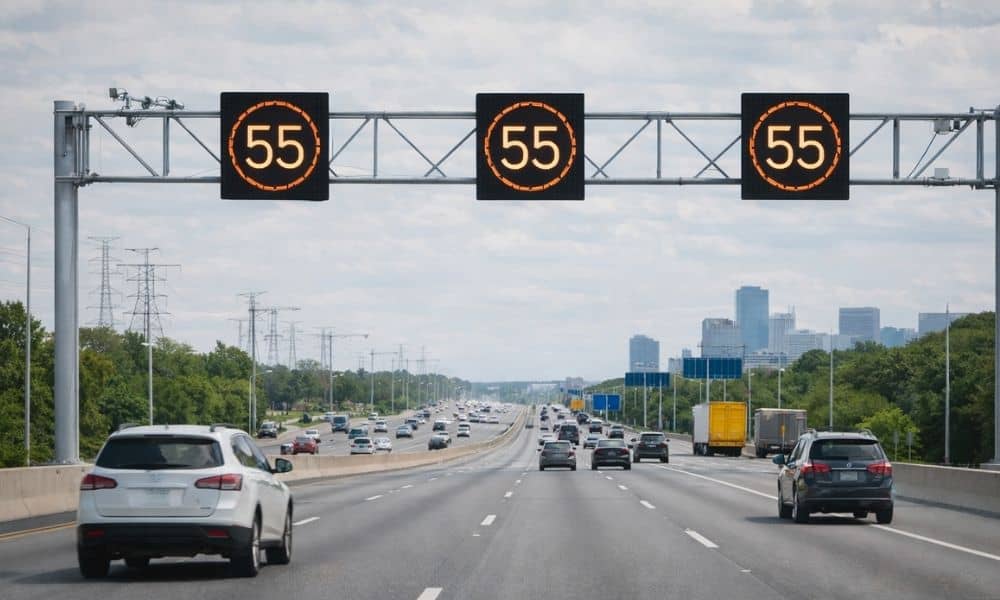
If you have driven I-24 recently, you may have noticed digital speed signs above the highway. These signs change during busy times. That system is called a Variable Speed Limit, or VSL.
Although it may seem like the speed changes for no reason, the system relies on real-time data. Sensors in the roadway measure vehicle speed and volume. Cameras monitor conditions. Weather reports feed into the system. Then software analyzes everything at once.
Instead of waiting for traffic to collapse, transportation engineering teams lower speeds before drivers reach a bottleneck. Because of that early adjustment, vehicles approach slow areas at a steadier pace.
That steady pace prevents sudden braking. And when drivers brake less, traffic stays smoother.
Why Slower Speeds Can Reduce Congestion
At first, lowering the speed limit sounds like it would make traffic worse. After all, why slow down when you already feel delayed?
However, sharp speed changes cause traffic waves. When drivers move at 70 miles per hour and suddenly meet 20 mile-per-hour traffic, hard braking spreads backward through the line of cars. Soon, hundreds of vehicles must stop.
On the other hand, if drivers approach that same area at 55 miles per hour, they adjust more gently. Cars stay spaced out. Traffic keeps moving, even if slightly slower.
In other words, steady flow matters more than top speed.
Transportation engineering focuses on keeping traffic stable. Stability reduces crashes, limits stop-and-go waves, and improves travel time over the long run.
The I-24 Smart Corridor in Nashville
Nashville does not experiment blindly. I-24 serves as one of the most studied smart corridors in the country.
Engineers worked with the Tennessee Department of Transportation to analyze years of traffic data. They studied repeat congestion points. They tested models and fine-tuned the system. Over time, they installed overhead signs that respond to real-time conditions.
For example, when traffic near downtown begins to slow, the system lowers speeds several miles upstream. Drivers may see 55 miles per hour instead of 70. Although that change feels slower, it often prevents a full stop later.
Because of this approach, traffic flow becomes more predictable.
That predictability matters not only to drivers but also to businesses and communities.
Why This Matters for Nashville’s Growth
Nashville continues to add homes, offices, warehouses, and retail centers. Each new development depends on reliable transportation corridors.
When congestion becomes unpredictable, developers face stricter traffic impact requirements. Freight companies struggle with delivery timing. Municipal leaders must consider costly road expansions.
However, smart transportation engineering solutions offer another path. Instead of expanding pavement alone, engineers improve how the system operates.
For commercial developers, smoother corridors can support site approvals and reduce mitigation costs. For logistics companies, consistent travel times improve scheduling. For local governments, smart systems cost far less than major highway reconstruction.
Therefore, Variable Speed Limits do more than reduce daily frustration. They support economic stability across the region.
When Variable Speed Limits Make the Most Sense
Although VSL systems perform well on I-24, they do not work everywhere. Transportation engineering always studies the full picture before applying a solution.
These systems work best where congestion repeats at similar times and locations. They also require strong sensor networks and reliable traffic data.
Because I-24 experiences daily peak-hour slowdowns, the system can respond effectively. Meanwhile, rural highways with low traffic volumes would not benefit as much.
Matching the right tool to the right problem remains a core part of transportation engineering.
A Smarter Future for Nashville Traffic
The I-24 Smart Corridor shows how traffic management continues to evolve. Instead of reacting after congestion forms, engineers now predict and prevent breakdowns.
Looking ahead, Nashville may expand similar systems across other corridors. Ramp meters, connected vehicles, and real-time signal coordination could work together with Variable Speed Limits. As a result, the entire network could operate more smoothly.
Transportation engineering no longer focuses only on concrete and asphalt. It now blends roadway design with data, modeling, and real-time control.
For a fast-growing city like Nashville, that shift matters.
The next time you see a lower speed posted on I-24, it may feel inconvenient at first. However, that small change may prevent miles of stopped traffic ahead.
And that is transportation engineering working quietly in the background — keeping Music City moving.