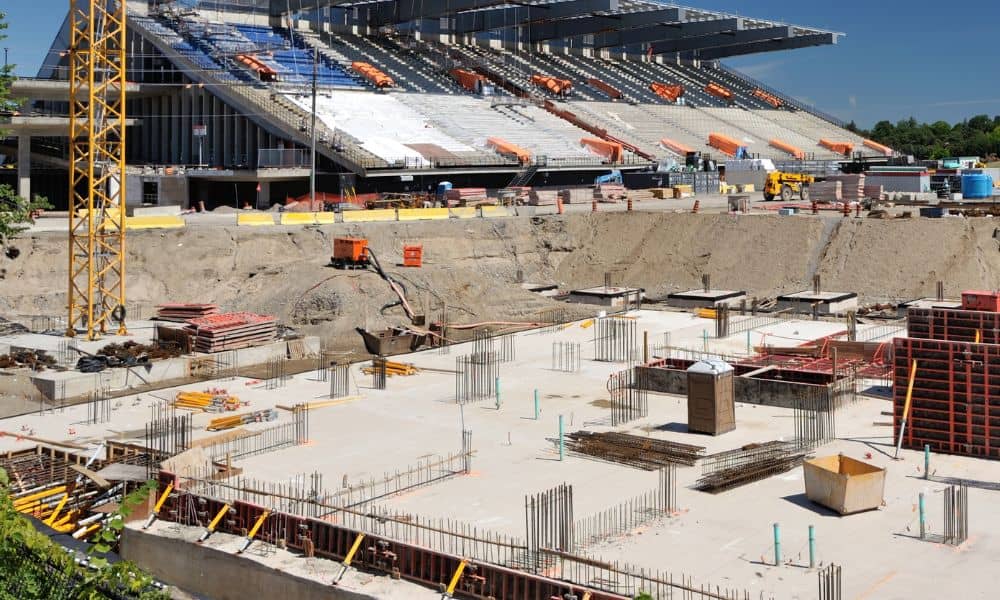
Nashville’s new Titans stadium just hit its halfway milestone, and the headlines focused on the budget, the steel, and the design. Yet one piece of the story rarely makes it into the news: the construction survey work that keeps a $2.1 billion project on track. Without precise survey control, the massive steel roof could tilt off line, the utilities under the East Bank could clash with new footings, and the entire schedule could fall apart.
This is the quiet, behind-the-scenes world of surveyors—the ones who make sure a mega-stadium rises exactly where it should. And while their work might look invisible to fans driving past, the lessons of this stadium apply to every project, from a neighborhood infill build to the next East Bank development.
The Hidden Compass of a Mega Project
Think of a construction survey as the compass of the building world. Every beam, slab, and pipe connects back to reference points set by surveyors. On a stadium this size, survey crews build a control network across the entire site, locking in the geometry so each trade—steel, concrete, or mechanical—knows where to start.
It’s not just about drawing lines on paper. Every week, surveyors confirm that the foundation, columns, and roof trusses align within fractions of an inch. If a misalignment grows, they catch it before steel crews waste days on a wrong installation. That accuracy is the difference between staying on budget or burning through millions in fixes.
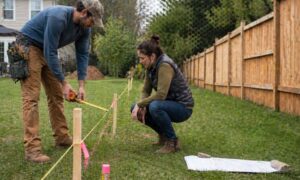
Even smaller jobs face the same risk. A house addition or a retail pad needs the same survey control—just scaled down. If a wall misses the property line or a storm drain slopes the wrong way, costs climb and delays follow.
Monitoring Roof and Structure Movement
The new Titans stadium includes a cable-supported roof with retractable features. That design demands constant monitoring. As crews tension cables and lift roof elements, surveyors track settlement and deflection in real time. If the roof settles unevenly, survey data alerts engineers immediately, so they can correct before damage occurs.
This type of monitoring isn’t just for pro stadiums. Apartment complexes, bridges, or warehouses also require structural checks during construction. Surveyors provide those measurements, giving project owners peace of mind that their investment stands straight and secure.
Laser Scanning to Prevent Clashes
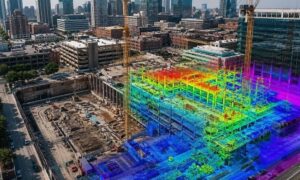
Traditional surveying isn’t enough for a site packed with steel, plumbing, and mechanical systems. That’s why surveyors bring in laser scanning. High-definition scanners create 3D models of the stadium each week. Engineers then compare the scans with the digital design.
If a steel beam intrudes into the space meant for ductwork, the clash shows up instantly. Crews fix it on the screen instead of after welding, saving both money and time.
For local contractors, laser scanning brings the same value. Whether it’s a downtown office renovation or a suburban school expansion, scans cut down on surprises. The upfront cost of scanning pales next to the cost of moving ductwork after it’s installed.
Drones in the Sky, Data on the Ground
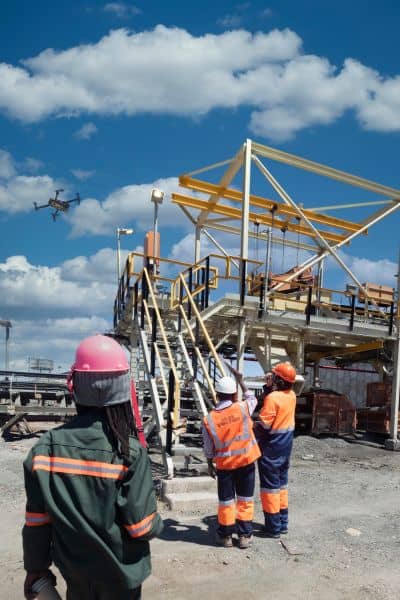
Surveyors don’t just work on the ground anymore. At the Titans stadium, drones fly overhead, capturing hundreds of images. Those photos build a 3D photogrammetry model that measures stockpile volumes, tracks earthwork progress, and checks schedules against reality.
Drone surveys also improve safety. Instead of climbing piles or entering tight spots, surveyors fly over and collect the same data in minutes.
This technology is quickly becoming common for Nashville-area projects. Developers use drones to track subdivision grading. Builders use them to prove quantities to lenders. Even residential clients ask for aerial photos to check drainage and lot conditions before buying land.
The lesson? Drone surveys are no longer optional—they’re a cost-saving tool.
The East Bank Challenge
The Titans’ new home sits on Nashville’s East Bank, an area with unique constraints. The site borders the Cumberland River, meaning floodplain considerations shape every decision. Under the ground, a web of utilities crisscrosses the area, while nearby traffic adds congestion.
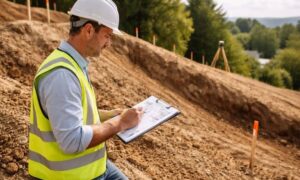
Surveyors manage these constraints with phased surveys. They locate utilities before excavation, verify elevations to meet flood regulations, and mark safe zones for crews. Each survey step reduces risk, not only for the stadium but also for surrounding infrastructure.
This mirrors challenges across Metro projects. Any property close to the river, a creek, or even a steep slope may face similar zoning and floodplain rules. A professional surveyor ensures compliance before the city rejects plans.
Why It Matters for Clients
It’s easy to think a $2.1B stadium has nothing in common with a home build or a retail strip. Yet the core truth is the same: construction surveys protect investments.
On the stadium, surveyors prevent million-dollar mistakes. On a smaller site, they prevent thousand-dollar mistakes, but for many owners, that cost is just as painful. Surveys keep projects moving forward, reduce RFIs, and speed up approvals.
Hiring a licensed surveyor isn’t an extra—it’s insurance. The upfront cost pays back through fewer delays, fewer errors, and fewer headaches.
Final Takeaway:
The Titans stadium shows what’s possible when surveyors guide the process from day one. But the same lesson applies if you’re building. The earlier you bring in a surveyor, the smoother your project runs.
So before concrete is poured or utilities are staked, call a licensed surveyor. The construction survey might not make headlines, but it is the secret behind every project that finishes on time and within budget.